When homeowners ask, “why is my remote control ceiling light not responding,” they often expect a quick battery replacement to solve everything. Sometimes it does. A weak battery can leave the indicator dim, while a tripped breaker can make the entire fixture appear lifeless. The problem may also involve lost pairing, radio interference, a blocked receiver, or an aging LED driver hidden above the ceiling.
Lighting designer and author Randall Whitehead offers a practical reminder: “Lighting should be designed for people, not just for fixtures.” That principle matters here. A remote-controlled ceiling light is a small system, not merely a lamp. The remote, receiver, wall switch, power supply, and bulbs must work together. If one part fails, the symptom can look identical.
Start with simple observations. Does the wall switch supply power? Does the remote produce a visible signal? Have fresh batteries changed anything? Try standing closer, then reset the light according to its manual. Some models require a precise power-cycle sequence, and timing matters. Others lose memory after a brief outage. Annoying, but common.
Do not assume the remote is faulty. The receiver may have failed. The light may also flicker, respond slowly, or turn on only after repeated commands. These details can reveal more than guesswork. Still, troubleshooting has limits. Loose wiring, heat damage, or ceiling-mounted electrical faults require a qualified professional. A careful diagnosis protects both the fixture and the person investigating it.
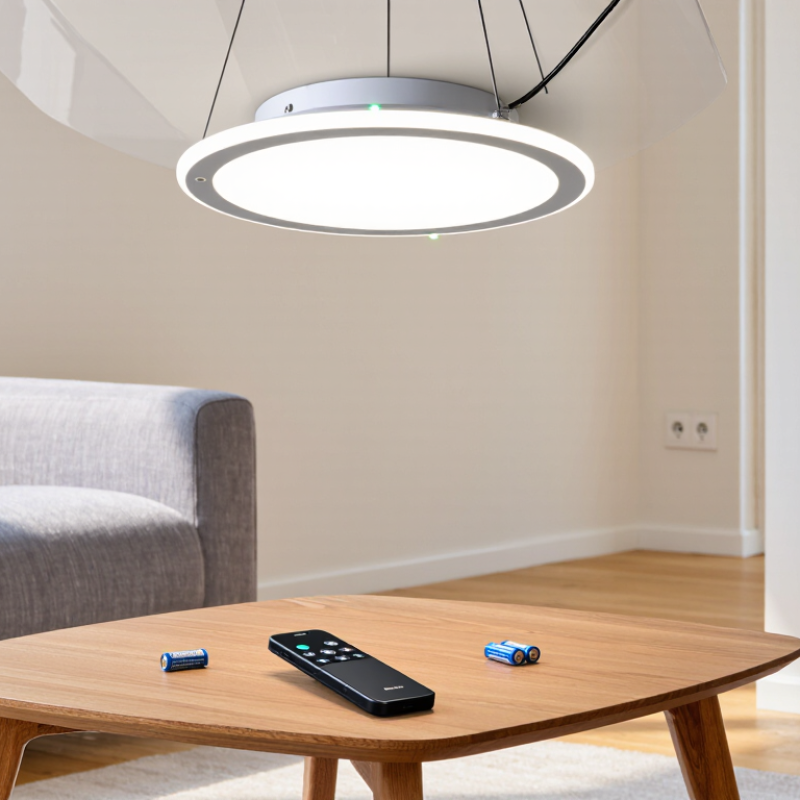
Why Is My Remote Control Ceiling Light Not Responding?
A dead remote battery is the most common suspect. Check both cells carefully, even if the buttons still flash. The U.S. Department of Energy reports that LED lighting uses at least 75% less energy than incandescent lighting, but the remote still depends on small batteries. Remove the batteries and inspect for leakage, swelling, or dull contacts. Install matching cells in the correct direction. A loose contact can feel like a signal failure.
Signal problems are easy to miss. Stand within three metres of the light and aim toward its receiver. Clear the area around the receiver, especially thick shades, metal fittings, or tall cabinets. Strong sunlight and nearby wireless devices may also create confusion. Press one button slowly. Repeated pressing can make troubleshooting harder. If the light responds only from close range, the remote transmitter or receiver may be weakening. My own mistake was testing from the sofa first. Distance hid the real problem.
Tips: Clean the remote’s front window with a dry cloth. Test fresh batteries in another compatible device. If there is no response, switch the light off at its wall control for one minute, then restore power. The U.S. Consumer Product Safety Commission advises following battery instructions and keeping damaged batteries out of use. Do not force the battery compartment. A professional electrician should inspect persistent faults, loose wiring, or unusual heat.
A fresh alkaline battery typically measures about 1.5 V. Remote-control performance can decline as voltage drops, while infrared signal reliability also decreases with distance and obstructions. Replace weak batteries, aim directly at the receiver, and test the light from a shorter distance.
A remote-controlled ceiling light may seem unresponsive when the real problem is its power supply. Check the wall switch first. It must remain on for the remote receiver to work. Then inspect the circuit breaker. A tripped breaker can leave the light completely silent, even when the remote has fresh batteries.
From my repair experience, power problems are often more common than remote failures. Turn the wall switch off, wait thirty seconds, and turn it on again. Watch for a brief flicker or startup sound. If the light remains dead, use a properly rated voltage tester, but only if you understand electrical safety. Never touch exposed wires. Loose connections, a weak neutral, or a faulty ceiling junction can interrupt power. These issues require a qualified electrician, especially when the breaker trips repeatedly. I once blamed a remote too quickly; the actual problem was a loose connection above the canopy.
Tips: Replace the remote batteries, but do not stop there. Test another outlet with the same circuit if practical. Keep notes about flickering, humming, or delayed startup. Those details help a technician identify unstable power. If the light works only after several attempts, avoid repeated cycling. The fault may be getting worse. Always switch off the breaker before opening any fixture, and verify that power is absent with an approved tester.
Inspect the receiver before replacing the light. Turn off the circuit breaker, then check whether the receiver’s wiring is loose, pinched, or overheated. A faint clicking sound can suggest a relay problem, but silence proves nothing.
Do not touch exposed terminals while power is present. I have found that a recently installed light often needs a pairing reset, not a new remote.
Press the pairing button according to the fixture’s instructions, then hold the remote’s power button near the receiver. Remove the batteries first and inspect for corrosion. Weak batteries can produce a flashing indicator without sending a reliable signal.
The U.S. Department of Energy reports that LED products use at least 75% less energy than incandescent lighting, but efficient LEDs still depend on healthy control electronics. The lamp may be fine.
Range matters. Test the remote within three metres, with the ceiling fan and other wireless devices switched off. Metal shades, reinforced concrete, and crowded radio environments can weaken transmission.
The Connectivity Standards Alliance explains that wireless range changes with building materials, interference, and device placement. That is why a remote may work beside the receiver but fail from a doorway. Try fresh batteries. If pairing repeatedly disappears, the receiver may be failing, although this diagnosis deserves another careful check before replacement.
A remote-controlled ceiling light may seem dead when its wall switch is simply off. Check the switch position and flip it fully on. Some fixtures need constant power before the remote can work. Replace weak remote batteries, then stand beneath the light and press the power button. Look for a small indicator response, if available.
Still nothing? Turn off the circuit breaker before touching the fixture. Use a voltage tester to confirm the wires are not energized. Remove the canopy only if you understand basic electrical safety. Inspect for loose wire connectors, darkened insulation, or a wire pulled partly from its terminal. Do not rely on wire color alone. Older installations may not follow expected patterns.
The safety controls deserve attention too. A thermal protector may shut the light down after overheating. Let the fixture cool for thirty minutes, then test it again. Some ceiling lights also contain a receiver, fuse, or reset switch inside the housing. Access can be awkward. I have found that rushing this step creates more confusion than progress. If the breaker trips, wires feel warm, or you smell burnt plastic, stop immediately. A licensed electrician should test the circuit and internal controls with proper equipment. Never bypass a fuse, safety sensor, or grounding connection.
A remote-controlled ceiling light may stop responding for simple reasons, but some signs point to electrical repair. Check the remote batteries and confirm the wall switch is on. If the light has a receiver, pairing may also need resetting. Stand beneath the fixture and watch for any flicker, buzzing, or delayed response. These details matter.
Turn off the circuit breaker before inspecting anything near the fixture. Never remove the canopy or touch wiring while power is available. If the breaker trips repeatedly, stop testing. A warm switch plate, burning smell, loose fixture, or visible scorch mark needs prompt attention from a qualified electrician. These symptoms can indicate damaged connections, overloaded wiring, or a failing receiver. Do not rely on the remote as proof that the circuit is safe.
Professional help is also sensible when the light works from the wall switch but ignores every remote command. The receiver may be defective, incorrectly connected, or incompatible with the fixture. An electrician can test voltage, inspect wire connections, and verify grounding with proper instruments. In service work, technicians often find that a “dead” light has two problems, not one. A weak battery can hide a wiring fault, or a loose connection can mimic remote failure. Home troubleshooting has limits. If you feel unsure, pause and arrange an electrical inspection rather than guessing.
Check the batteries, wall switch, receiver, and pairing status. A recently installed light may need pairing again.
Turn off the circuit breaker before checking anything near the fixture. Look for loose, pinched, or overheated wiring.
A faint click may suggest a relay problem. Silence does not prove the receiver is dead.
Follow the fixture instructions for pairing. Hold the remote’s power button near the receiver during the reset.
Remove them and inspect for corrosion. Weak batteries may flash an indicator without sending a reliable signal.
Test it within three metres. Metal shades, concrete, and wireless interference can weaken the signal.
Stop if the breaker trips repeatedly, the switch feels warm, or you smell burning. Visible scorch marks also need prompt attention.
The receiver may be defective, incorrectly connected, or incompatible. An electrician can test voltage, wiring, and grounding.
Yes. A weak battery can confuse the diagnosis. A loose connection can mimic remote failure.
No. This diagnosis is not perfect. Pause when uncertain and arrange a professional inspection.
If you are wondering, “why is my remote control ceiling light not responding,” begin with the simplest possibilities. Replace the remote’s batteries, check that the buttons are working, and make sure the signal path is clear. Confirm that the ceiling light has a dependable power supply by checking the wall switch, circuit breaker, and any visible signs of interrupted power. If the remote still does not work, the receiver may need to be paired again, or the remote may be outside its effective operating range.
Next, inspect the light’s switch, wiring, and built-in safety controls for obvious problems, but do not open electrical components unless you are qualified to do so. Flickering, burning smells, damaged wiring, repeated tripped breakers, or a complete lack of response may indicate an electrical fault. In these situations, turn off the power and contact a licensed electrician for safe testing and repair.
