In 2026, choosing lighting means balancing comfort, appearance, flexibility, and installation constraints. Track lighting and recessed downlights can both illuminate a room well, but they solve different problems. Track heads sit visibly on a rail and can be redirected toward a reading chair, kitchen counter, or artwork. Recessed fixtures tuck into the ceiling, creating a quieter look and spreading light across selected areas. Neither option is automatically better.
The practical question is how to choose between track lighting and recessed downlights for your actual room. Start with ceiling access, room layout, and the tasks people perform there. A low ceiling, exposed joists, or a renovation with limited access may affect what is feasible. So can glare, dimming compatibility, beam angle, and the location of furniture. Details matter. A bright spot on a painting may look crisp, while the same beam can feel harsh across a glossy countertop. Recessed lights may appear unobtrusive, yet poorly spaced fixtures can leave dark patches or make a ceiling feel busy. Track systems offer adjustability, though the rail itself remains visible. That trade-off is easy to underestimate.
This guide compares light quality, installation considerations, energy use, maintenance, and costs without treating one layout as universal. Recommendations depend on the specific fixtures and room, so check product specifications and consult a qualified lighting professional when wiring or ceiling conditions are uncertain. A simple plan helps. Sketch the room, mark key surfaces, and test where light needs to land before choosing.
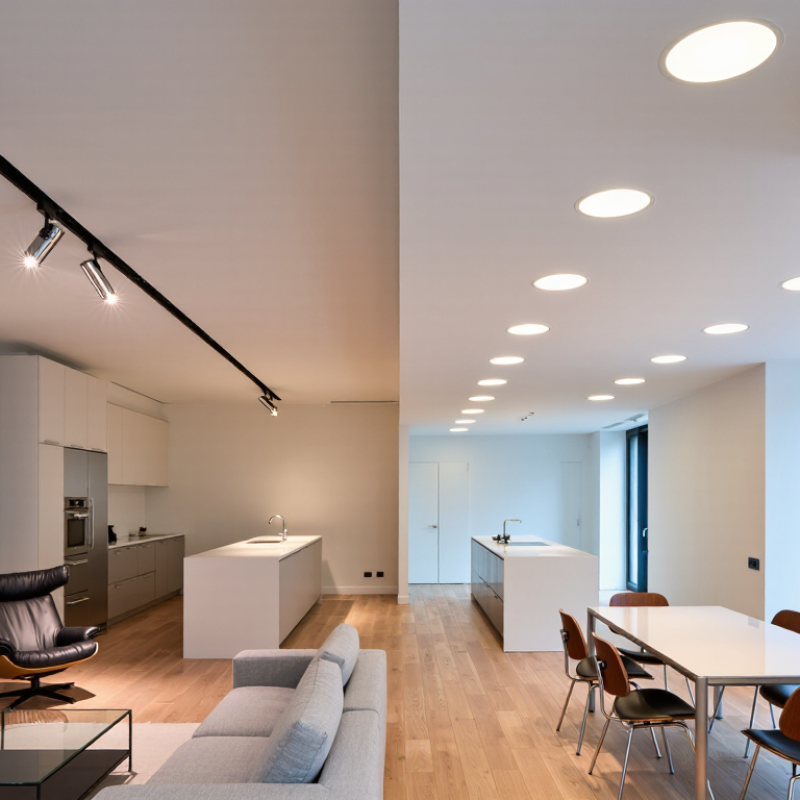
Track lighting uses a surface-mounted rail that carries adjustable light heads. The rail can follow a straight line, turn a corner, or highlight a dining table. Each head can be aimed at a bookcase, artwork, or work surface. That flexibility is useful when a room’s layout may change. The visible rail also becomes part of the room’s appearance, which some people enjoy and others find distracting.
Recessed downlights sit inside the ceiling, leaving a trim ring or aperture visible. They create a quieter, more integrated look and can provide even general illumination when spaced carefully. However, their position is less flexible after installation. A poorly placed fitting may cast shadows across a kitchen counter or create bright pools on the floor. Ceiling depth, joists, insulation, and access above the ceiling can affect what is practical. Not every ceiling can accommodate them easily.
The main difference is not simply modern versus traditional; it is adjustable versus fixed light. Track heads can be redirected, but their beams may produce glare if aimed carelessly. Downlights can look tidy, yet too many can make a ceiling feel crowded. Consider where people read, prepare food, or walk at night, then test beam angles and spacing on a plan. A slightly imperfect layout may still work better than a perfectly neat pattern that lights the wrong places.
A practical comparison for residential and commercial spaces. Actual performance, installation requirements, and costs depend on the specific fixtures, ceiling construction, electrical system, and local codes.
| Decision factor | Track lighting | Recessed downlights |
|---|---|---|
| How it works | Multiple fixture heads attach to an electrified track. Heads can often be repositioned along the track and aimed at different areas. | Individual fixtures sit in ceiling openings and direct light downward or, with adjustable models, at an angle. |
| Best suited to | Accent lighting, artwork, display areas, flexible workspaces, and rooms where lighting targets may change. | General ambient lighting and clean, low-profile illumination across rooms, corridors, kitchens, and other regularly used spaces. |
| Aiming and flexibility | Usually offers strong adjustability: heads can be aimed, and compatible heads can be moved along the track. | Fixed models illuminate a set area. Adjustable or gimbal models can direct light, but moving a fixture usually requires installation work. |
| Ceiling appearance | Track and heads are visible, so the system becomes part of the room’s visual design. | Most of the fixture is hidden above the ceiling, creating a more integrated appearance. |
| Installation considerations | Often surface-mounted, which can make it useful where a ceiling cavity is limited. It still needs suitable wiring, mounting, and support. | Requires ceiling cutouts and enough space above the ceiling for the chosen housing, wiring, and any required clearances. IC-rated fixtures are designed for contact with insulation when installed as specified. |
| Renovation and retrofit | Can be a practical option when adding directional lighting without installing several ceiling openings. Existing electrical conditions still need assessment. | Can work well in new construction or suitable retrofit projects. Replacing existing fixtures may require matching the opening, housing, and wiring conditions. |
| Light distribution | Can provide focused accent or task light; the result depends on head optics, beam angle, aiming, and spacing. | Can provide broad or focused downward light depending on reflector, lens, beam angle, and spacing. Poor placement can create uneven pools of light. |
| Glare and visual comfort | Exposed light sources may be visible from some viewing angles. Shielded, deep-set, or well-aimed heads can help reduce discomfort. | Trim design, source depth, beam control, and placement affect glare. Recessed fixtures are not automatically glare-free. |
| Energy use | Depends mainly on the lamps or integrated LEDs, their wattage, quantity, and operating time—not on the track format alone. | Also depends mainly on the light source, wattage, quantity, controls, and operating time. Compare delivered light and efficacy on product specifications. |
| Dimming and controls | Dimming is possible when the track heads or lamps and dimmer are compatible. Check the fixture’s control specifications before purchase. | Dimming is possible with compatible fixtures, drivers, and controls. LED dimmer compatibility can vary by model. |
| Maintenance and changes | Individual compatible heads or lamps may be replaceable, and head positions can often be changed without altering ceiling openings. | Access and replacement depend on the fixture type. Some integrated LED models require replacing the complete fixture or module. |
| Cost factors | Consider track length, number and type of heads, mounting, wiring, and any required electrical work. Costs vary by project and specification. | Consider fixture quantity, housing and trim, ceiling access, wiring, cutouts, and finishing or repair work. Costs vary by project and specification. |
| A useful selection rule | Choose track lighting when adjustability, visible fixtures, or changing focal points are priorities. | Choose recessed downlights when a discreet ceiling appearance and planned, consistent downward illumination are priorities. |
It suits changing spaces, such as a kitchen island or reading chair. Aim each head at the task.
They create a quieter ceiling and can provide general light in hallways or compact rooms. Plan spacing carefully.
Check ceiling depth, joists, ducts, insulation requirements, and access for maintenance. Measure twice.
Often, yes. Track sits below the ceiling, but the rail remains visible.
Aim track heads away from seated eyes, screens, and glossy counters. Test the view from the sofa.
Yes. A fixture directly above a countertop may cast a shadow from the person working there.
Yes. Use downlights for general light and track heads for a table or display. Check that their color appearance and dimming work together.
Track heads can be redirected if the room’s needs change. Recessed lights stay fixed, so placement matters from the start. I still find the choice less tidy than it sounds.
Choosing between track lighting and recessed downlights begins with understanding how each system shapes a room. Track lighting offers adjustable fixtures that can highlight artwork, work surfaces, or changing room layouts, while recessed downlights create a more integrated, understated look. Ceiling height and construction, room proportions, natural light, and the need for focused or general illumination all influence which option will work best.
To decide how to choose between track lighting and recessed downlights, compare their beam control, flexibility, potential glare, and installation requirements. Also consider energy use, compatibility with smart controls, maintenance, and long-term costs—not just the initial purchase. Track lighting may suit spaces where lighting needs change or accents matter; recessed downlights may be preferable when an even, low-profile appearance is the priority. In some rooms, combining both approaches can provide balanced ambient and task lighting.

